

HEADLESS
SEARCH
ENGINE
Lightning-fast search that works everywhere. One index for every channel
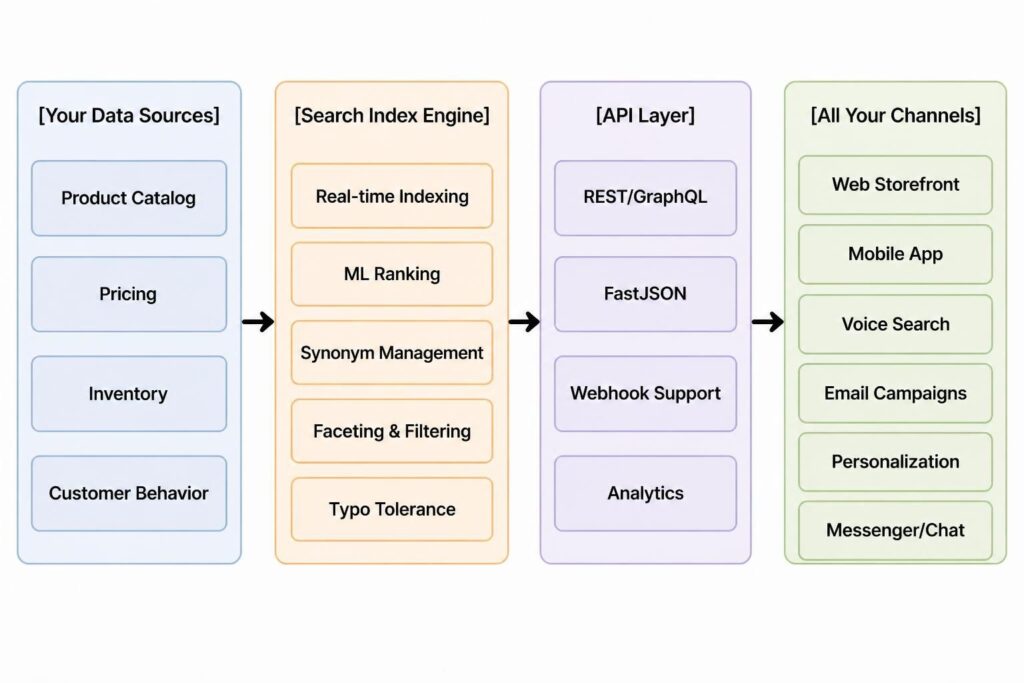
The API-first search engine for headless commerce. Lightning-fast product search, intelligent autocomplete, and faceted navigation for online stores, mobile apps, voice assistants, and more—all from one single, unified index.
What makes Quarticon’s headless search engine special
Headless commerce makes it possible to operate an unlimited number of frontends through a single commerce platform. A search engine should work in the same way. Instead of integrating the search logic into each individual online store, it is implemented once and made available across all channels. Conventional database searches are slow, inflexible, and designed for a single online store. Headless commerce requires a better solution: a dedicated search engine that serves all channels with latency under 100 ms, intelligent ranking, and cross-channel insights.
Faster search experiences
Database queries take 500 ms to 2 s. Searches are abandoned before the results have loaded. The conversion rate drops by 10–15% for every second of latency.
A specially developed search index delivers results in <100 ms. Instant results while typing. Higher engagement and increased revenue.
Better search relevance
Generic keyword search delivers irrelevant results. The desired products are not found until the third or fourth attempt. Niche products remain undiscoverable for customers with specific search queries.
Machine-learning-based ranking takes search intent, popularity, margins, and inventory into account. More intelligent results, higher conversion.
Omnichannel experience
Search integrated into an online store works only on the web. Separate search logic is required for the mobile app. Email search is not possible.
A unified index serves the web, apps, voice assistants, email, and social media. Consistent results everywhere.
What Sets Quarticon AI Search Apart
Lightning-fast mobile search
Mobile users receive instant results with images, prices, and reviews before leaving the store.
No waiting for loading. No scrolling. Just pure conversions.
Catch the user within 3 seconds
Convert every visit
Smart autocomplete, contextual suggestions, and backup results ensure everyone finds what they need or something even better.
No more lost sales.
No more wasted traffic
Mastery in niches
Contextual search rich in parameters understands niche specifics. “Organic cotton nursing bras” returns exactly those products, not general matches.
Specialist categories gain visibility.
Demand and inventory management
Excess stock sells faster. Fast-moving products highlight limited availability. Stock shortages trigger smart alternatives.
Inventory starts generating revenue instead of piling up and being a hindrance.
Turn inventory into revenue. Smartly.
Forgiving user errors
Typos don’t eliminate results. Synonyms and abbreviations work. Natural language queries work correctly.
Customers find what they want—regardless of how they search.
Let your products be found, even with misspellings
Insight into customer needs
See customer queries, searches returning 0 results, and keywords driving sales.
Finally, understanding customers instead of guessing.
Search analysis that truly works.
How the headless search engine works
Connect data sources
The product catalog (SKU, title, description, price, attributes) is integrated from the commerce platform, PIM system, or data warehouse. Real-time synchronization keeps the search index up to date. Updates become available within seconds, rather than after hours.
Index instantly
Products are indexed immediately and can be found at once. Our distributed index is replicated across global data centers. No waiting for batch jobs or overnight rebuilds.
Intelligent Search
The frontend sends a search query to our API. Our engine delivers ranked, relevant results in <100 ms—considering popularity, margins, inventory, user behavior, and personalization rules. Typos are forgiven, synonyms recognized.
Intelligent Autocomplete
As input is provided, search suggestions (query autocomplete) and product recommendations (product autocomplete) are delivered instantly. The system learns from customers’ actual search patterns.
Faceted Navigation
Results can be refined using filters: price, brand, color, size, and rating. The number of hits per facet is updated in real time as filters are applied. No delays.
Learn and Optimize
Data is captured on what is searched for, what is clicked, and what converts. These insights can be used to adjust ranking, identify content gaps, and better understand customers’ search intent.
Features of the Headless Search Engine
API-First Architecture
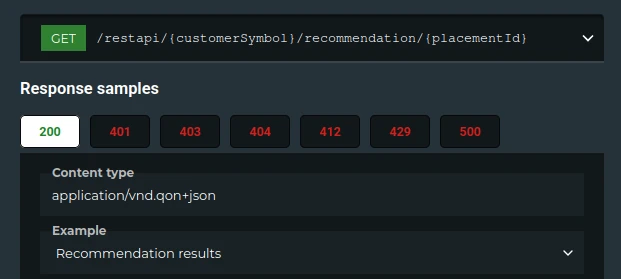
Any frontends—web apps, native mobile apps, email services, or even IoT devices—can request recommendations via REST APIs. Language-agnostic and deployment-agnostic.
Search Latency Under 100 ms
A purpose-built search index optimized for speed rather than analytical queries. Results are delivered from any geographic region in fewer than 100 milliseconds. Instant results as users type, as expected.
Intelligent Ranking and Relevance
More than simple keyword matching. ML-powered ranking considers:
Seasonal trends
Search intent and search query context
Product popularity and sales dynamics
Margins and business rules
Inventory availability
Signals from user behavior
Typo Tolerance and Fuzzy Matching
Search queries can be misspelled—yet the desired products are still found. “Bleu chees” finds blue cheese. “Runnign shoes” finds running shoes. No results are lost due to typos.
Synonym Management
Custom synonyms for the company can be defined. “Running shoe” = “Training shoe” = “Sneaker”. Management is performed via the dashboard or API.
Faceted Navigation
Dynamic filtering by price, brand, color, size, rating, category, and custom attributes. The number of hits per facet is updated in real time as results are refined.
Auto-completion and Search Suggestions
Two types of auto-completion:
- Search query auto-completion: Suggestions for search terms based on typical search queries
- Product auto-completion: Matching products are displayed as text is entered
The system learns from customers’ actual search patterns. Suggestions can be personalized for each user.
Support for Multiple Languages
Indexing and search in more than 50 languages. Stemming, accent-independent search, and language-specific ranking are integrated.
Merchandising and Merchandising Rules
Highlight products for certain search queries or place them lower in results:
- “Running shoe” → Highlight Nike, place competitor brands lower
- “Summer dresses” → Highlight clearance stock items
- “Gaming laptop” → Prioritize high-margin SKUs
Rules can be updated at any time without rebuilding the index.
Personalization at Scale
Customize search results individually for each user:
- Display products from customers’ preferred brands first
- Present items similar to previous purchase history
- Highlight products that have been viewed but not yet purchased
- Display prices according to customer segment
And all of this without impacting search latency.
Dashboard for Analytics and Insights
Real-time insights into:
- Most frequent search queries and search volume trends
- Click-through rate per search query
- Conversion rates per search query
- Search queries with no results (content gaps)
- Search funnel analysis
- A/B test results
Identify opportunities to improve catalog and ranking.
A/B Testing
Test ranking strategies, merchandising rules, and auto-completion variants. Direct users to the test variant and measure impact on click-through rate, conversion, and revenue.
Use Cases of the Headless Search Engine
E-Commerce Web Shop
The React-based web shop has a search bar, but loading results takes 800 ms because the main database is queried. Search operations are abandoned. Browsing categories generates more traffic than search.
The solution: Replace database queries with API calls to the search engine. Same search bar, instant results (<100 ms). ML-based ranking presents more relevant products. Customers find what they’re looking for faster.
Additional benefit: Analytics show what customers are searching for. “Waterproof jacket” is searched 500 times per month but converts at only 2%. This indicates a catalog gap or ranking problem that can be fixed.
Result: 25–40% higher conversion rates for search queries; 15–20% more search traffic because users trust search more.
Search in Mobile Apps
Mobile search is cumbersome. Typing on small keyboards is difficult. Users need instant auto-completion and fast results. However, building a mobile-optimized search infrastructure is costly.
The solution: The iOS/Android app uses the same search API as the web shop. The backend is handled by us, while the app is responsible for the UX. Auto-completion is triggered with each keystroke. Results appear in <100 ms.
Advantages specifically for mobile devices:
- Smaller result sets by default (faster processing on mobile networks)
- Simplified facet controls for small screens
- Integration with mobile analytics
Result: Search becomes a central way to discover products on mobile—not just browsing the homepage.
Voice Search and Smart Speakers
Voice assistants (Alexa, Google Home) cannot query the database directly. Building voice search from scratch requires speech recognition, NLP, and dialog-oriented logic.
The solution: The voice skill or action sends the user’s voice-transcribed search query to our API. The three most relevant results are returned with extensive metadata. The voice application formulates the answer naturally.
Example: “Alexa, search my shop for waterproof jackets under $100.” → Our API delivers ranked results in <100 ms → Alexa reads the results aloud.
Result: A new discovery channel; voice commerce grows 3 to 5 times faster than expected.
Multi-Brand and Multi-Shop Companies
Ten web shops are operated (with different brands, regions, and languages). Each requires its own search index with its own ranking and merchandising rules. Managing 10 separate search systems quickly becomes a nightmare.
The solution: Separate search engine instances are provided for each brand or region. Thanks to the unified API layer, the development team needs to integrate only once; each index remains independent.
Result: Brand autonomy; no data leaks; scaling to dozens of web shops.
Marketplace and Seller-Generated Content
Third-party sellers continuously add products. The search index cannot keep pace with this speed. New products are not discoverable for hours.
The solution: Seller product updates are transmitted directly to our index via API or webhook. Indexing occurs within seconds. Sellers can track their own search analytics.
Result: Real-time marketplace experience; happier sellers; better customer experience.
Built for Modern Headless Architectures
Contact
Increase conversions from unregistered visitors with a lean, lightning-fast search engine.
- All platforms via a REST API
- Integration with Segment, mParticle, Tealium, or native event streams for transmitting behavioral data to the engine
- Send search events, performance data, and customer profiles for analysis to Snowflake, BigQuery, or Redshift
Talk to our team (schedule a 30-minute demo)
Fill out the form below – contact will follow promptly.
FAQ
How does this solution differ from a simple database query or search built with Elasticsearch?
The problem with database queries
The product database (PostgreSQL, MySQL, or another system in use) is optimized for transactional queries, not search. When entering “blue running shoes,” the database searches through millions of product records and matches keywords in titles and descriptions. This takes 500 ms to 2 seconds. By then, the search may have already been abandoned or a competitor’s website visited.
Moreover, a database search does not account for relevance. Results are returned based on exact matches or simple keyword scoring. A product titled “Running Shoes Blue Men’s Nike” could be ranked below “Blue Shoes” solely due to word order. There is a lack of intelligent assessment of what customers are actually searching for.
The problem with Elasticsearch
Elasticsearch is powerful but ultimately a data warehouse. Management must be handled internally: provision servers, configure clusters, handle sharding, optimize queries, update versions, and resolve performance issues. Building production search with Elasticsearch requires:
- DevOps expertise for reliable operations
- Search engineers to optimize relevance
- Infrastructure for monitoring and alerting
- Scaling logic as the catalog grows
- Enhanced security measures to prevent data breaches
The operational costs are underestimated by most teams. A small team managing Elasticsearch often dedicates 30–40% of development time to search infrastructure instead of product features.
Our approach: The operational and relevance-related challenges have already been solved. The infrastructure is managed by us, scaled globally, and provided by default with intelligent ranking.
| Aspect | Database Search | Elasticsearch (self-managed) | Quarticon Search |
|---|---|---|---|
| Latency | 500 ms–2 s | 100–300 ms (with good optimization) | <100 ms guaranteed |
| Relevance | Simple keyword search | Good (optimization required) | Excellent (ML-powered, learns from your data) |
| Operations | Initially simple, fails at scale | Complex, DevOps required | Fully managed, no in-house maintenance required |
| Scaling | Expensive queries at large scale | Cluster management required | Automatic, transparent scaling |
| Global Performance | Single region | Manual replication required | Multiple global edge locations |
| Ranking Customization | Limited | Possible but complex | Simple dashboard, no code required |
| Analytics | Must be built custom | Must be built custom | Real-time dashboard included |
| Fault Tolerance | No, unless custom built | Possible but optimization required | Built-in, learns from your searches |
| Autocomplete | No, unless custom built | Separate systems required | Native autocomplete engine |
| A/B Testing | No, unless custom built | Complex implementation | Built-in, one-click activation |
How is the search index kept in sync with the product catalog? What happens when thousands of products are changed daily?
When inventory updates but search results become outdated, customers see products that are out of stock or miss new products. Manual reindexing (nightly recreation of the entire search index) results in stale data for hours. Real-time synchronization is essential but complex.
Here’s how the problem is solved: Real-time updates via API (fastest) Whenever a product in the commerce platform changes, an update is immediately sent to us.
The product is indexed within 500 ms. New inventory levels, prices, and availability are immediately reflected in search.
Scheduled batch synchronization (flexible) Upon request, the entire catalog can be synchronized once daily or hourly. Data is retrieved from the API or database, compared with the current index, and only changes are applied. Full catalog synchronizations take only seconds even with over 1 million products.
Webhook integration (automatic) When the commerce platform (Shopify, BigCommerce, SAP) sends webhooks on product changes, direct monitoring can be set up:
- Product created → indexed immediately
- Product price changed → updated in index
- Stock changed → search filters updated
- Product deleted → removed from index
Inventory management Handling of unavailable products is configurable:
- Option 1: Do not display unavailable products in search results
- Option 2: Display them at the end of results with a “Notify” button
- Option 3: Display them with a note “Coming soon”
The choice should align with business strategy.
What about historical data? When migrating from another search system, historical data can be imported retroactively: The entire catalog is imported in one step via bulk upload. Afterward, real-time synchronization is set up for ongoing updates. The initial import takes 15–30 minutes for 500,000 products; afterward only changes are synchronized.
How much does search performance actually influence conversion rate and revenue? How is success measured?
A slow search significantly impairs the conversion rate. Studies show:
- Every increase in latency by 100 ms = 1% fewer conversions
- For users employing the search function, the conversion rate is 2–3 times higher than for users browsing categories (when the search is effective)
- Poor search results → users switch to another website
Typical improvements observed by our customers:
| Metric | Typical Increase | Range |
|---|---|---|
| Search conversion rate | +25–40% | 15–50%, depending on baseline |
| Search traffic | +15–25% | More users trust search when it’s fast and relevant |
| Average order value from search | +5–12% | Better ranking = better product recommendations = higher spending |
| Overall website conversion rate | +8–15% | Search typically accounts for 20–30% of conversions; improved search increases overall value |
| Reduction in no-result search queries | 60–80% | From 2–3% to 0.3–0.5% |
| Autocomplete usage | 50–70% | Search sessions utilize suggested terms; enormous time savings |
Everything can be tracked: adding to wishlists, email signups, loyalty program enrollments, revenue distribution by category. These actions are marked as custom conversion events; subsequently, the impact of search on them is demonstrated.
Can ranking and search behavior be customized to meet business requirements? (Highlight specific products, rank competitors lower, seasonal rules, etc.)
Yes, customization options are unlimited. No coding is required for many use cases.
The following options are available:
- Merchandising rules (highlight products/rank lower)
- Example 1: Seasonal merchandising; during Q4 (holiday season), gift sets and product bundles should be highlighted: IF season = “Q4” AND category = “gifts”THEN boost(weight = 1.5)
- Example 2: Inventory-based merchandising; from the previous season, excess stock of winter coats exists. During the clearance sale, these should be highlighted: IF inventory > 500 AND price < cost * 1.2 THEN boost(weight = 1.3)
- Example 3: Margin-based ranking; for electronics products, margins range from 5 to 30%. High-margin products should be highlighted: IF margin > 25% THEN boost(weight = 1.2)
- Example 4: Rank competitor products lower; electronics products are sold. Competitor brands should not be displayed prominently (they are merely carried as supplements). They are ranked lower: IF brand IN [“Competitor_A”, “Competitor_B”]THEN bury(weight = 0.5)
- Ranking customization (adjust algorithm). Default ranking considers:
- Relevance (40%): How well does the product match the search query?
- Popularity (30%): Sales volume, ratings, sales velocity
- Inventory (15%): Prefer in-stock products
- Business rules (15%): Margins, promotions, merchandising
- These weights can be adjusted via the dashboard without changing code
- Different strategies for different customer segments:
| Customer Segment | Ranking Strategy |
|---|---|
| First-time buyers | Highlight popular products with many reviews |
| VIP/loyalty program members | Highlight high-margin products typically purchased |
| Price-conscious customers | Highlight products under $50 |
| Premium customers | Highlight luxury brands and premium segments |
- Personalized ranking. Search results can be customized based on behavior for individual users: IF customer_has_viewed_brand = “Nike”AND customer_purchase_history = “athletic” THEN boost(Nike_products, weight = 1.3). Results for the search for “running shoe”:
- User 1 (Nike fan): Nike shoes at positions 1–3
- User 2 (Adidas fan): Adidas shoes at positions 1–3
- Both continue to see overall relevant shoes, but their preferences are taken into account
- Handling typos. Flexible tolerance for typos can be permitted. The desired degree of strictness can be set:
- Strict (no typos allowed): Exact matches only
- Moderate (1–2 typos allowed): “Runnning shoe” finds “Running shoe”
- Tolerant (3 or more typos allowed): “Bleu chees” finds “Blue Cheese”
- Highlighting by price range. For price-sensitive search queries, products in the mid-price segment are highlighted: IF query = “budget” OR query = “affordable”THEN boost(products WHERE price < $50, weight = 1.4)
What about multilingual and international search? Can global product catalogs be processed?
In global distribution, the product catalog likely includes multiple languages, regional variants, and different currencies. A search query in French should return French-language results and account for French grammar and accents. A German customer searching for “shoe” should be shown shoes. This is complex. More than 50 languages are natively supported.
Does Quarticon offer a search engine for traditional retail?
Yes. In traditional retail, where frontend and backend (inventory, payments, order processing) are tightly integrated into a single monolithic system, Quarticon offers its search engine as a regular JS-based implementation, as a mixed JS/API implementation (Semi-API), and as a pure API implementation. More information: AI search engine
Where can more information about available API methods be found?
More information: Quarticon Search Engine API
What is Quarticon?
Quarticon is a technology company that provides AI tools for e-commerce. The company was founded in 2010 in Warsaw. It developed its own predictive AI models that contribute to increasing conversions and revenues in online stores. Quarticon offers AI-based product recommendations in numerous European countries, including Poland, the Czech Republic, Slovakia, Hungary, Croatia, and Serbia.
More information about Quarticon: About Quarticon